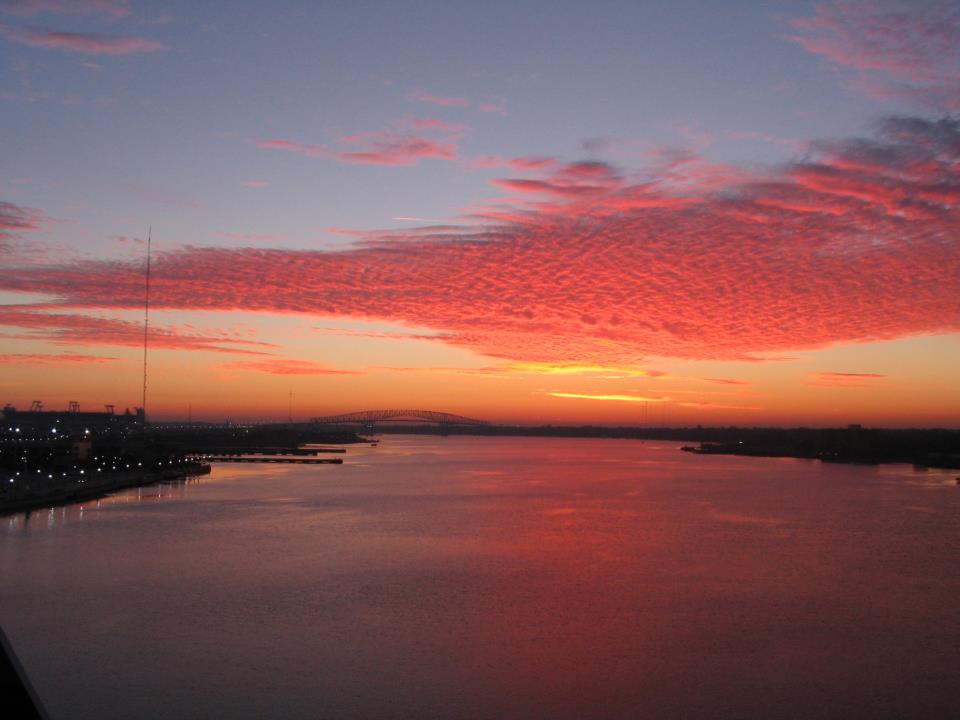
I am so in awe of nature. Sometimes it stops me dead in my tracks and I get tears in my eyes. I am just so grateful that I am able to live on this planet, and I’m equally ashamed that humans seem to be so hellbent on destroying it. Nature is miraculous. The things that are happening every single day in nature are things we could never reproduce ourselves, even if our lives depended on it (and they do).
Don’t believe me? Create a vegetable from scratch. I dare you.
And take, for example, noctilucent clouds. I didn’t even know these things existed until about 24 hours before this writing. Once again, the sheer quantity of things that I have yet to learn slaps me upside the head at the most unexpected of times, and I’m so grateful for that. Thank you, universe, for that insight.
The way I learned about this amazing weather phenomenon was by being shown the two pictures that appear below. They were taken by my friend Bill Wainwright at approximately 3 a.m. on two separate nights. Aren’t they beautiful?
I had never seen anything quite like that in all my 55 years. With a little research I found out that they are called noctilucent clouds, and they are still barely understood. According to Wikipedia, there’s no confirmed record of their sighting before 1885 (two years after the eruption of Krakatoa), and yet it seems that their occurrence is increasing in frequency, brightness, and extent.
A whole series of circumstances have to come together just right in order for you to be treated to a sight such as this. First of all, it has to be the summer months in your area, and you need to be between latitudes 50 and 70 degrees above or below the equator. (That means, sadly, that I will not be seeing noctilucent clouds from my back yard. Bill lives a lot further north than we do.) There need to be sufficient ice crystals in the atmosphere, and the sun needs to be below the horizon.
Noctilucent clouds are the highest clouds in our atmosphere, about 50 miles higher up than any other clouds, and they are so wispy that you can’t see them once the sun has risen. Apparently they require water vapor, dust, and very cold temperatures (around -184 degrees Fahrenheit) to take shape.
No one knows where this dust comes from. It could be from micrometeors or from volcanoes, but those are just theories. We still have a lot to learn about noctilucent clouds.
But even as I wallow in my ignorance about this particular subject, I remain in awe. Nature is spectacular. Regardless of how they come about, I’m happy that noctilucent clouds exist, and I’m grateful for those who manage to take pictures of them.

Photo courtesy of Bill Wainwright.

Photo courtesy of Bill Wainwright.
Do you enjoy my random musings? Then you’ll love my book! http://amzn.to/2mlPVh5



Leave a Reply to The View from a DrawbridgeCancel reply