
This first section is a brief explanation of my Italy blog posts, which were inspired by my 2-week trip to Italy in May, 2025. Feel free to skip this part if you’ve read it before.
Dear Reader, If you’ve read my Italy posts in the order in which they’ve come out, it may seem as though we hopped back and forth all over the country, but I have decided not to write these posts sequentially. I want to write about the things that interest me most, as the spirit moves me. For some topics, I may even combine cities. I hope that by doing so, you’ll find it a lot more interesting than if I just give you a tedious day by day description of our itinerary, as if I were your Aunt Mabel forcing you to sit down and watch all her Super 8 films of the family road trip to Niagara Falls from 1966.
If you have any questions, comments or suggestions about how I’m approaching this travelogue-within-a-blog, please let me know in the comments below!
The Age of Enlightenment, also known as the Age of Reason, lasted, roughly, between 1610, when Galileo published a book in which he describes his discovery of 4 moons orbiting Jupiter, and 1794, the end of the Reign of Terror in the French Revolution, when 17,000 nobles, priests, and political opponents were executed and 10,000 more died in prison without trial, thus challenging one of the core principles of the Enlightenment: that an egalitarian society could govern itself.
In a gross oversimplification, the Age of Enlightenment had been an era in which Man used and celebrated reason to make sense of their world. Their ultimate goal was to improve their own condition through knowledge, and by doing so, increase their freedom and happiness. They were inspired by the philosophers of ancient Greece, the classical scholarship of the Renaissance, and the scientific revolution of the late Middle Ages. The enthusiasm, curiosity, and willingness to question societal assumptions is what appeals to me the most about this age. (Of course, there was also a great deal of religious and conservative pressure to keep things the same, to prevent new ideas and silence knowledge, so that those applying the pressure could maintain their power and hold onto their wealth. Some things never change.)
At the beginning of that era, people (mostly white males) who were rich enough to have leisure time and sufficient education would form scientific societies, and/or perform independent scientific experiments out of curiosity. Science became all the rage. They would sponsor less affluent scientists so that they could pursue certain avenues of inquiry. They would also display elaborately designed instruments in their homes to proclaim their intellect, and they would often demonstrate experiments at social functions to the delight of their guests. (It is said that Benjamin Franklin enjoyed showing the ladies that he could make their hair rise with static electricity.)
As more food became available and more people were able to lift themselves up out of poverty, literacy increased, and lecture courses became popular. Women, who were barred from universities, frequently attended these lectures. Coffeehouses became places of public discourse. Science was one of the many popular topics. Scientific books written in an entertaining way were published at a greater frequency and were quite popular.
This period gave rise to numerous inventions and scientific discoveries, including (in no particular order):
- 4 of Jupiter’s moons
- Sunspots
- Microscopes
- Barometers
- Peer reviewed scientific journals
- Cells
- Epigenesis in insects
- The light spectrum
- Mechanical calculators
- Pendulum clocks
- The speed of light
- Reflecting telescopes
- The three physical laws of motion
- The determination of longitude
- Gravity
- Pressure-Cookers
- Piston engines
- Steam-powered water pumps
- The plant classification system
- The Leyden jar
- Latent heat
- The determination that lightning is electrical
- Lightning rods
- Thermometers
- Refrigeration
- Thermodynamics
- Inoculations
- The atmosphere of Venus
- Steam engines
- Weighing scales
- The discovery of oxygen
- The discovery of Uranus
- Steamboats
- Demography
- Hot air balloons
- Parachutes
- The use of foxglove to treat dropsy
- Sewing machines
- Telegraphs
- The discovery and mapping of the gulf stream
- The law of ideal gases
- The law of conservation of mass
- The birth of modern chemistry
I wish I had read more about these scientists, even the amateur ones, when I was young. Their desire for knowledge, their enthusiasm, their curiosity might have given me some much-needed perspective. During my secondary education, I thought I hated science. That’s because I was taught that science was for boys, and even the boys seemed to hate science in my rural, backward Florida school. It didn’t help that the teachers also seemed to hate to teach it. I was never inspired to like science, and it never occurred to me that it was even in the realm of possibility for me.
It wasn’t until I was a great deal older that I realized that I actually do enjoy science. But by that time, starting over and getting an extensive education for a completely different career seemed out of reach. Time marches on, and opportunities become less abundant as we age. (I remember the feeling of having so many options that I was overwhelmed and practically paralyzed by the fear of it. I had no idea what a luxury that was. The world will not always be your oyster, young people! Enjoy it while you can!)
Now, I mainly indulge in my love of science by being called a nerd. I go to museums. I read about scientific discoveries. I watch documentaries. I get interested in a subject and read all I can about it. My heroes are people like Benjamin Franklin, Charles Darwin, Jane Goodall, Noam Chomsky, Virginia Apgar, Stephen Hawking, Cecilia Payne-Gaposchkin, Marjorie Courtenay-Latimer, Leonardo da Vinci, Hope Jahren, Ignaz Semmelweis, Henrietta Leavitt, Neil deGrasse Tyson, Mary Leakey, Herodotus, Margaret Mead, and Galileo. So, yes, science is still a big part of my life. It could have been bigger, but there’s no point in speculating.
Suffice it to say that I instantly thought, “Yes, please!” when I was researching the Florence part of our Italy trip and stumbled upon the Museo Galileo. That site instantly went to the top of the “must see” list. And, unlike many venues in Florence, such as the Uffizi Gallery right next door, it does not require reservations weeks in advance if you are to have any hope of getting in. Yes, the museum offers online ticket purchases, but they’re by no means necessary.
We nerds are a minority. We just walked up to the counter, bought our tickets, and strolled right in. There was no line.
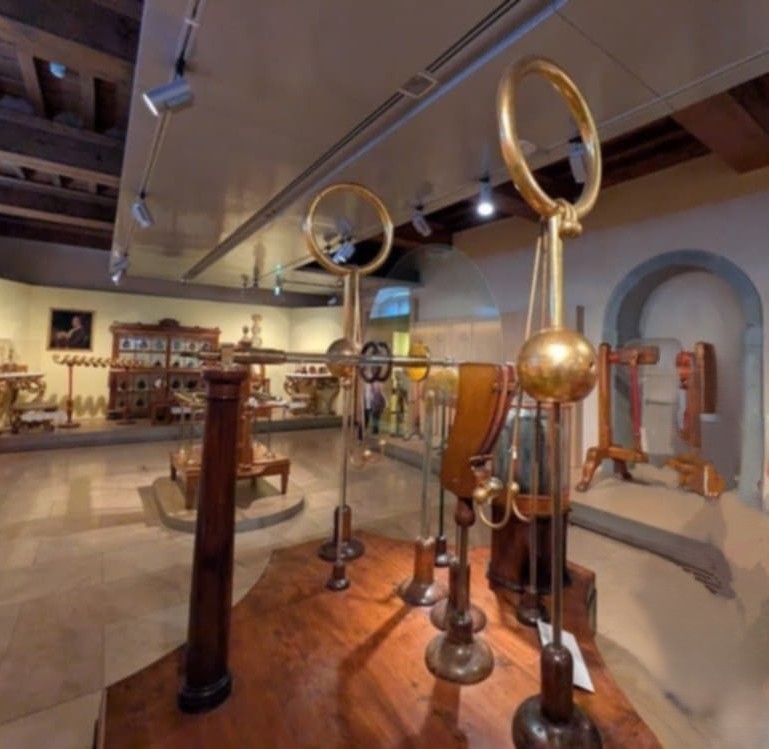
After experiencing it, even allowing for my nerd bias, I have to say that the lack of interest in this museum is shocking. Every invention in the building was not only a breakthrough in its time, but was also a work of art.
These things were clearly born out of a love of science. Of course they’d turn them into things of beauty. I’m sure there were other motivations for embellishing these devices as well. As I said, many were on display in the homes of the elite. Others, being used by scientists who had sponsors, were probably designed to impress those sponsors. And it would be much easier to draw people to your side, as opposed to that of the anti-science faction, if you gave them pretty toys to play with. I’m also convinced that craftsmen of the time took more pride in their work than modern ones do. And ultimately, let’s face it, even though alchemy and astrology were beginning to lose credibility, there was still quite a bit of overlap going on, and to many, science must have seemed like another magical thing, and magical things should require magical-looking contraptions.
As Dear Husband and I wandered through this museum, I was struck by the difference between these devices and the cold, plain appliances of today. Modern instruments get the job done. They’re streamlined and as cost effective as possible. I’m sure they’re much easier to keep clean. But the beauty and the love for design is gone.
Even if the explanations that accompanied all the 17th century scientific contraptions in the museum often went right over my head, just gazing at them was well worth the price of admission. They were exciting to look at. I longed to get my hands on them. I can understand why they would have seemed enchanting to the average person in the early days of the Enlightenment.
Here are some of the photos DH and I took of these apparatuses during our visit:


I left the Museo Galileo feeling thoughtful. From all the scientific inquiry of the Age of Enlightenment arose a faith in the human capacity to attain knowledge. This, of course, led to a resistance to authoritarianism and blind faith. The general populous no longer wanted to be blindly obedient and be told what to believe by monarchs or religious leaders. They remembered that they had brains and could use them. They began to question things. They began to consider concepts such as democracy, human rights, egalitarianism, a secular rule of law, and a separation of powers. They started to talk about reform.
When the masses begin to think for themselves, though, the more conservative elites lose power. We can’t have that, now, can we? Heavens no! That group, when desperately trying to hold onto power, will do their best to make you think it’s better to be blindly obedient. It’s better to shut yourself off from new ideas. They will start by censoring what you get to read. They’ll encourage books to be banned. They’ll restrict what you can be taught. They’ll prevent you from being exposed to any ideas that are different than their own.
Those in power do not want you to be able to think independently. They must make you afraid of being exposed to other perspectives. They must convince you that such exposure will corrupt you, as if you have no control over the person that you are, that you can’t form your own opinions, and that being exposed to differences will force you to become someone that you don’t want to be, rather than becoming someone who is more tolerant of the wider world.
In order for the powerful to maintain their power, they desperately need everything to stay exactly as it is. They think things are great, and they want you to think things are great, too, even if they’re not particularly great for you. They want you to fight to keep things great. For them.
Increased knowledge, exposure to the wider world, and asking questions is not a danger to you. If you truly have faith in your free will and your moral compass, the more information you have, the more your character will become refined, not flawed. Forcing yourself into darkness and ignorance is what allows you to be manipulated by outside forces that do not have your best interests at heart. It was true in 1610, and it remains true today.
One of the Enlightenment’s most enduring legacies is our belief that human history is a record of continual progress. That’s unfortunate, because I think we’ve become complacent. That continual progress needs to be nurtured and actively defended. Do not allow those who are motivated by greed halt our forward momentum for their sole benefit. It would be such a tragedy if we have to waste time recovering ground we could have already gained were it not for ignorance, fear, and neglect.
One of the oddest things on display in the Museo Galileo is Galileo’s actual right middle finger. There it is, for all to see. It might not even register in your mind if you’re not specifically looking for it. It’s that strange. In 1737 it was snapped off his desiccated corpse and kept like some sort of religious relic.
That’s ironic, considering the fact that he was considered a religious heretic and spent the last 9 years of his life under house arrest for daring to say that the earth revolved around the sun. You get the opportunity to hear his tragic story in the museum as they provide you with a virtual reality experience of it at no additional charge. It was fascinating to experience.
After that virtual trip back in time, I looked at this finger and wondered how it should be interpreted. Was it a personal violation of the body of a great man who did so much for the world? Was it just another European body relic in a culture that has a macabre fascination for such things? Was the finger pointing toward the skies that Galileo gazed at so intently through his telescopes? Was it encouraging us to look up, beyond our petty little differences, toward those things we have yet to discover?
Or, as my cynical mind tends to believe, was it a massive f*ck you to all of those who still, nearly 400 years after his death, try to prevent the pursuit of knowledge and understanding? You be the judge.


Leave a Reply