
Trigger warning: brief description of torture, and extremely harsh prison conditions.
This first section is a brief explanation of my Italy blog posts, which were inspired by my 2-week trip to Italy in May, 2025. Feel free to skip this section if you’ve read it before.
Dear Reader, If you read my Italy posts in the order in which they’ve come out, it may seem as though we hopped back and forth all over the country, but I have decided not to write these posts sequentially. I want to write about the things that interest me most, as the spirit moves me. For some topics, I may even combine cities. I hope that by doing so, you’ll find it a lot more interesting than if I just give you a tedious day by day description of our itinerary, as if I were your Aunt Mabel forcing you to sit down and watch all her Super 8 films of the family road trip to Niagara Falls from 1966.
If you have any questions, comments or suggestions about how I’m approaching this travelogue-within-a-blog, please let me know in the comments below!
I never thought, in my wildest dreams, that I’d be wandering around the Doge’s Palace in Venice someday. In my first, 5-hour visit to Venice many years ago, I only saw the exterior of the Doge’s Palace and the Cathedral, each with lines of tourists snaking out into the square. There was only time to take in the view from the bell tower, feed the pigeons, seek out a good meal, and cross the Rialto Bridge before rushing back to our hydrofoil.

This time, though, with Dear Husband, I had more time. So here we were, guests of the Doge, if one still existed. I’m kind of glad one doesn’t, though. Back in the day, unless you were one of the elite few, being in the Doge’s palace could be a harrowing experience.
But before we harrow, let’s talk about the palace’s ability to awe, impress, and intimidate. If you had the good fortune to be there for non-threatening reasons, you were hit with opulence and lavishness beyond your wildest imagination. Some of the more sumptuous rooms included the Chamber of the Great Council, the largest hall in Europe with no supporting pillars, which includes artwork by Varonese. Along the ceiling, you see the portraits of all 76 doges that ruled the Republic at one time or another, although one portrait was blacked out (the leftmost in the photo below) after that doge was convicted of treason and beheaded.

That room also sports the longest canvas in the world (which you can see behind the Doge’s throne in this warped, panoramic photo.) It is Il Paradiso by Tintoretto. It’s about 80 feet long and 32 feet high.

To truly get a sense of how huge this room is, though, you really should take a look at DH’s short Video. I have to admit that when I stood in the center of this room, I kept looking up at the ceiling for reasons other than admiring the artwork. How the hell has that ceiling managed to avoid caving in?
Another room has a zodiac clock and a clock that runs counterclockwise. And everywhere you look, you see gilding, marble sculptures, elaborate wood carvings, ornate windows, and masterpieces by the most significant artists of the day. These rooms were not only designed to impress the visitors, but to emphasize how successful, powerful, and sanctioned-by-God the Republic of Venice was. It was important to the Venetians that all foreign dignitaries left the palace feeling that it would be ill-advised, and, in fact, futile, to mess with them.


One painting that really indicates how badly the Venetians wanted to demonstrate their wealth and economic strength is known as “The Tree of Coins”. In it, you see the Venice skyline, and then a tree full of gold coins, symbolizing their riches. The different words on each coin represent the various titles, roles, or virtues that allowed Venice to become a financial powerhouse. It mentions various aspects of the government, trade, and civic responsibility. Words such as justice and wisdom are common.

I’m not sure that visitors to the palace were allowed to see the armory, but it is a fascinating display of the power of the Republic of Venice. We know that it has existed since at least the 14th century. Not only did it include their own weaponry, but some that were gifted to them by foreign dignitaries, and others that were the spoils of war. A lot of it came from King Henry IV of France, for some reason.
Originally, the Council of Ten stockpiled weapons in the armory to be used by the palace guards when necessary. A lot of it was disbursed after the fall of the Republic, but 2000 items still remain. I was particularly fascinated by the armor for horse’s heads. There are also suits of armor, shields, swords, crossbows, arrows, quivers, halberds, firearms, standards, and ships’ lanterns. And, this being the Doge’s Palace, there are implements of torture.


Oddly enough, there is also a chastity belt in there, but I must not have known what I was looking at. I know I’d have taken a photo if I had, but I didn’t even get a picture of it by accident. So here’s one of it from the internet. It would render you inaccessible, yes, but I’m sure it would also have taken you out of the mood entirely, so it worked on more than one level.

Since we’re hinting at violence, let’s now dive deeper into how the sausage that we call the Republic of Venice was actually made.
This was not the kind of palace we’ve been taught to visualize thanks to Walt Disney, all opulence, turrets, hallways, and a rarely used or visited dungeon. It wasn’t just the place where the leader of the land resided. There was more to it than his sumptuous apartments, banquet halls, and meeting rooms. This complex was the governmental hub of the Republic of Venice. Here you found the Great Council, the Senate, the Full Council, the Council of Ten, the State Inquisitors, the archives, the State Censors, the State Advocates, the Chamber of the Navy Captains, and the three Councils of Forty.
This is also where the Golden Book and the Silver Book were kept. To be considered part of the Nobility of Venice, the legitimacy of your marriages and births (no breeding with commoners!) had to be recorded in the Golden Book. The Silver Book held the names of citizens who were “civilized” and “honorable” and were of ancient Venetian origin. Your name had to appear in this book if you wanted to become a state bureaucrat, especially if you aimed to work in the Doge’s Palace.
When you enter the palace, you find yourself, first, in the courtyard. There you can see two wells that date back to the mid-16th century. These used to be the palace’s only sources of water. Beyond them, though, is the Giant’s Staircase. The senators used to gather in the courtyard and then ascend this ceremonial staircase before attending any meetings. It was often the first impression people had of the place, and it gave it a sense of pomp and formality. From there, you could find all of the offices mentioned above, facing the courtyard on one floor or another.


While you could be invited to the palace as a dignitary, or you could go there to conduct various types of bureaucratic business, the Council of Ten was the Council you really wanted to avoid. It was set up in 1310 after a doge and some noblemen tried to overthrow the system of government. (That would be the doge whose portrait got blacked out.) The Council of Ten maintained order in the Republic through a system of fear, intimidation, and espionage.
People were encouraged to inform on their friends, family, and neighbors if they felt they were engaging in things like blasphemy, occult practices, seducing young girls, espionage, or breaking any law at all, no matter how insignificant. For that reason, Informants’ Postboxes, or Mouths of Truth, were placed all over the city, but especially in the Doge’s Palace.
This one, installed near all these bureaucratic offices, basically says, “Secretly denounce anyone who accepts bribes or favors: otherwise, they will be kept hidden, and their true actions will never be revealed.” Its primary focus was exposing corruption or dishonesty among officials. It must have been intimidating to work in one of those offices and see people who were dissatisfied with your customer service approaching those postboxes, because if you were accused, you could face serious consequences.

The Council of Ten turned the Republic into a full-on authoritarian regime. It was supposed to be temporary, simply to try those conspirators in 1310. But it was given so much power that it quickly held authority over all sectors of public life, from religious orthodoxy to foreign policy to espionage to state security. It was made up of ten members of the senate that were chosen by the Great Council. They sat in council with the Doge and his 6 counsellors.
The council of Ten was ruthless. They had eyes everywhere. Their hearings were held in secret, and their sentences were handed down rapidly. Quite often, people who had to appear before them had no idea why, and when they left, it was to go directly to the prison in the same complex, never to see the light of day again. This was also the council that would determine who would be beheaded.
The prisons in the Doge’s Palace were horrible. They make our modern, overcrowded, unsanitary human warehouses seem like luxury hotels. There were three different circles of hell you could find yourself in if you were accused of a crime in the Republic.
The worst prison in the palace was the Pozzi (the Wells). These were 18 underground cells, close to the canal. They were always damp, dark, and disease-ridden. There was no air circulation or light, and the ceilings were so low in the cells that you could not stand upright. They were on two levels, with a torture chamber in the center. These cells were generally reserved for the lower classes and for those who committed the most serious crimes.
But all prisoners spent at least a brief period there, because before you were to be interrogated, you’d be placed in one of these dark cells. Often, actors would be hired to moan and scream from the torture chamber area throughout the night, so that when your turn came, you’d be more apt to confess quickly. (You’d have to pay me a heck of a lot to take on that acting gig.)
A typical interrogation would start with the accused standing on the raised platform in the vaulted torture chamber. His hands would be tied behind his back, to a rope that stretched up to the ceiling. He would be asked questions. If the interrogator felt that he was lying, or if he felt he wasn’t being told what he wanted to hear, the rope would be tightened by slow increments, until the most stubborn victims would eventually be hanging in the air by their wrists, from dislocated shoulders.
As I stated earlier, the Pozzi cells on both levels circled the torture chamber. So if you were already sentenced to any length of time in Pozzi, you got to bear witness to the agonized screams and flailings of those who were being interrogated. This, no doubt, reminded you of your own initial torture experience. The Pozzi and the torture chamber operated from the 12th century until 1797, when the Republic fell to Napoleon.
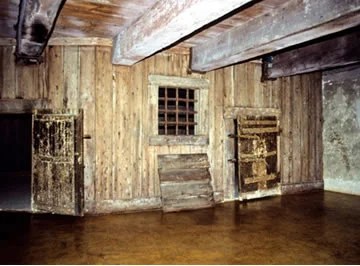
Dear Husband and I did not get to tour the Pozzi, so here are some images I pulled off the internet, including the vaulted central torture chamber with its rope and platform.


1n 1590, the Republic decided to expand their prison system. 18 cells were no longer enough. And the Pozzi cells were deemed to be too inhumane for prisoners from the upper classes. Also, the harsh conditions in the Pozzi were creating such a stench that it was wafting out into the Palace courtyard, and we couldn’t have that, now, could we?
So in 1591, 7 more cells were added up in the attic, under the lead roof. That prison was called the Piombi, for Lead. While these cells got some sunlight and air circulation, and they weren’t damp, that lead roof meant that they were blisteringly hot in the summer, and bitterly cold in the winter. But at least you could stand upright, and you were allowed to bring your own furniture, and have decent food delivered. Just like the Pozzi, the Piombi continued to function until the fall of the Republic in 1797.
The most famous inmate in the Piombi was Casanova. The charges seem to have been “an affront to religion and common decency.” He spent about two months in the Piombi without knowing the reason for his arrest. Then, without a trial, he was sentenced to 5 years in prison.
He escaped 16 months later, and you can read his fascinating description of how he managed to pull that off, because he wrote Story of My Flight 30 years later, and it was a very popular publication. (You can also read the Reader’s Digest version of the escape on his Wikipedia page.) Due to all his shenanigans, he had to flee to Paris, where he got into more trouble, and then to Germany, and then, well, he gallivanted around Europe for the next 18 years, until 1774, when the Inquisitors in Venice took pity on him and let him come back home.
But Venice was no longer the same for Cassanova. His reputation preceded him, and his years of hard living, faded youth, and small pox scars made him less attractive in the social circles in which he once thrived, so he could not find the financial support he once relied on. He managed to get himself expelled from Venice again in 1783 because he wrote a vicious satire about Venetian nobility. Word reached him in 1797 that the Republic of Venice had fallen, and he realized he’d never see his home again. He died a year later in what is now the Czech Republic. The location of his grave has been forgotten.
The third Prison, connected to the Doge’s Palace and called the New Prison, was added in 1614. It was actually in a building across a side canal from the palace proper, and could be reached by way of the famous Bridge of Sighs. This prison could house 400 inmates, and kept going, like the others, until 1797. While conditions were better in this facility than in the other two, it was still considered inhumane by modern standards.
Here are some photos we took while on the prison portion of our visit to the palace. I’m also including a diagram that shows the prison placements. The Pozzi takes up the two short bottom levels, the Piombi is the attic, and you can see the Bridge of Sighs that leads to the New Prison on the left. The other rooms were where you’d basically be sentenced with no real due process.


For those who have been living under a rock, the Bridge of Sighs is so named because it is said that as prisoners crossed over it, they’d get their last glimpse of Venice out its windows and sigh. Having been to Venice, I can certainly understand why. Here are our photos of the bridge itself, as well as the last views they would have had from both sides. Sigh.


An interesting side note about the New Prison. In 1991, a guy lagged behind his tour group and hid in one of the cells there. In the middle of the night, he crossed back over the Bridge of Sighs and into the Censor’s Chamber and stole a painting from the 1500’s called Madonna col Bambino. He then sold it to the Venetian Mafia. It was recovered by the police a month later.
For what it’s worth, nowadays, prisoners in Venice are held in the modern Santa Maria Maggiore Prison. Supposedly, this prison emphasizes spiritual growth, personal development, and reintegration into society. (Hard to say how much of that is true and how much is good PR.)
Before we say goodbye to the Doge’s Palace, in all its glory and with all its complicated history, I wanted to leave you with this image, because I keep thinking about that day in 1797 when Napoleon took over. What must it have been like for all those Venetian bureaucrats and nobles to walk out of that palace, knowing it would be for the last time?
This 1887 painting, by Vittorio Emanuele Bressanin, depicts a senator descending the Giants’ Staircase in the Palace, as Napoleon’s troops waited in the lagoon on that fateful day. The Great Council had just abdicated, and there would never be a doge in the palace again. That the artist portrayed the senator as being old and resigned to his fate makes him a symbol of Venice itself at that moment. Despite all their abuses of power, I can’t help but feel a little bit sorry for them when I look at this masterpiece . . .

. . . but I get over it when I look at the photo of the torture chamber.
Sources
Wikipedia—Prison of Santa Maria Maggiore
The prisons of the Doge’s Palace in Venice: how and who designed them and who escaped
Guide To The Doge’s Palace In Venice: What To See, Masterpieces + Tips
Doge’s Palace Venice Prisons: History and Tour
The Torture Chamber of the Doge’s Palace: A Lesson in History

Leave a Reply