
It’s a small island. You’d think Haitians and Dominicans would have learned to get along by now. Not so much.
In May, the Dominican Republic ruled that if you were born of Haitian parents any time after 1929 (which means, basically, all of them) you would be stripped of your Dominican citizenship and deported. Never mind that these people have lived there all their lives, and have never even been to Haiti.
But to make matters even worse, the government is refusing to provide them with any proof of their existence. Haitian-Dominicans cannot get their birth certificates or any form of identification. That means even if they do get deported, no one will take them. And if they stay, they can’t go to university or get any kind of white collar job, and have to live in constant fear of being stopped on the street by police and asked for papers that they can’t produce. People with bright futures, who have been offered full ride scholarships, are forced to become construction workers. These people have no options. They are basically without citizenship and without hope, simply because of who their parents were.
What did they do to deserve this? Maybe it’s because it’s a small island. You’ve got two groups of culturally distinct people competing for limited resources, and Haiti is one of the poorest countries on the planet, so that has got to count for some border tension.
Here’s what’s wrong with the small island theory: North America is a big continent, and America shares a border with a much poorer Mexico, and we’ve been treating Mexican-Americans like crap for as long as there have been Mexicans and Americans. So size apparently doesn’t matter in this instance.
I think it has more to do with economics, fear and prejudice than anything else.
When the economy is bad and there are few jobs to go around, people get scared and they want to blame someone. In this case, the Haitian-Dominican minority makes an excellent scapegoat. The same thing happened in Nazi Germany. The economy tanked, so the people blamed the Jews.
And then there’s prejudice. I could go on for pages offering up examples of groups of people who have been abused and marginalized simply because of their race or creed. Apparently Dominicans tend to reject their African heritage, whereas Haitians embrace it, and, well, we can’t have that, now, can we?
Suffice it to say it’s not a good time to be Haitian-Dominican. And while all this is going on the world apparently feels content to look the other way. Why should we get involved, after all? It’s not like they have oil or anything. It’s not like this tiny island has any significance to our daily lives, right?
I leave you with this poem written in 1946 by Martin Niemöller, a German theologian and Lutheran pastor.
“First they came for the communists,
and I didn’t speak out because I wasn’t a communist.
Then they came for the socialists,
and I didn’t speak out because I wasn’t a socialist.
Then they came for the trade unionists,
and I didn’t speak out because I wasn’t a trade unionist.
Then they came for the Jews,
and I didn’t speak out because I wasn’t a Jew.
Then they came for the Catholics,
and I didn’t speak out because I wasn’t a Catholic.
Then they came for me,
and there was no one left to speak for me.”
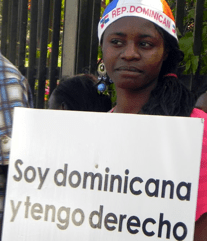
[Image credit: The Record at Fordham Law]



Leave a Reply